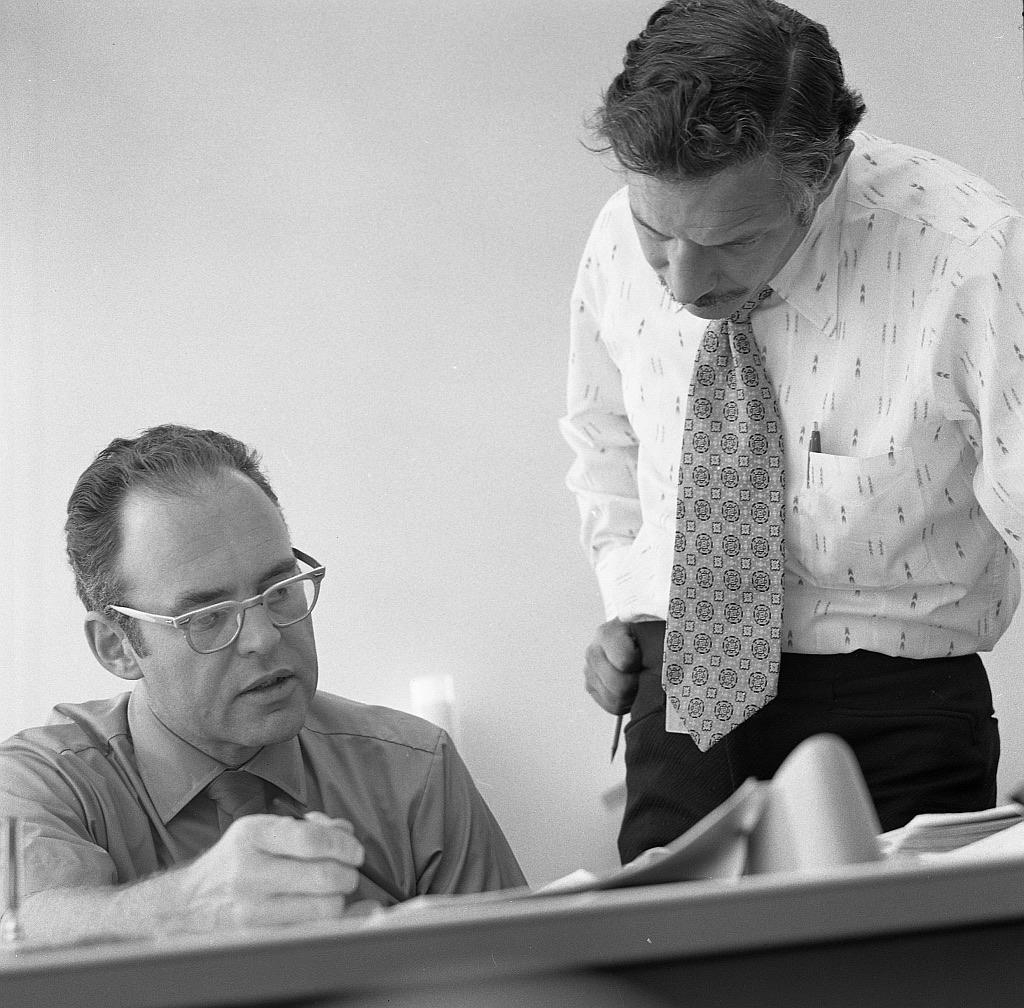
 Gordon Moore and Robert Noyce at Intel, 1970. Photo: Intel Free Press, CC BY-SA 2.0.
"The number of transistors on a chip will double every two years."
Gordon Moore, writing in Electronics magazine, working from five data points. He called it a guess.
It has held for sixty years.
It is the floor the rest of this story stands on. Scroll on.
↓
July 1969
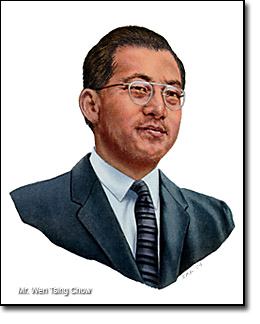
The Saturn V that carried Apollo 11 was steered by an IBM computer in the rocket's instrument ring. My uncle, Wen Tsing Chow, was the scientific advisor on its design. He had already invented programmable read-only memory and built the first solid-state computer to fly in space, for the Atlas missile. I grew up hearing about this, and it still amazes me.
The guidance computer inside the spacecraft itself ran on integrated circuits carrying six transistors each. That is the dot on the left.
Portrait: U.S. Air Force, Space and Missile Pioneers, 2004.1971 to 2019
Two years after the Moon landing, Intel shipped the 4004, some 2,300 transistors on one chip and the first microprocessor anyone could buy. Then Moore's guess simply kept coming true: the line follows the record holder, chip by chip, and doubles about every two years for five decades.
Zoom out
Pull the frame back to today and the same line goes vertical. Everything in the dashed box is the chart you were just looking at. The record chip now carries hundreds of billions of transistors; the Apollo chip's six would not register as a pixel.
The turn
What is less understood is that AI is not just riding Moore's curve; it is building new exponentials on top of it. To see that, the y-axis has changed to a logarithmic scale, which turns the doubling of transistors into a straight line. Every line from here on is also divided by its own 2012 level, the year AlexNet made GPUs the engine of AI, so the AI curves can be read against that steady doubling. On this axis a straight line is a constant doubling time, and steeper is faster.
Training compute
The compute used to train the largest AI models has doubled every since 2012. Moore's Law manages a doubling every . That is roughly AI doublings for every one the chips deliver; the rest is money and scale, more accelerators running for longer.
Accelerators
An accelerator is the chip that does the training: a GPU or a purpose-built part like a TPU, measured here by how many arithmetic operations one chip can do per second at the precision used for training. Its throughput has doubled every since 2008, faster than transistor counts, because these chips also grew larger, more specialized and better fed with memory. Faster chips explain part of the compute line; the rest is buying more of them and running them longer.
Parameters
Parameters are the basic units of learning in a large language model, the numbers it adjusts as it trains, and they are often compared to the synaptic connections in a brain. Many things determine how capable a model is, but parameter count is the figure most often used to compare the relative power of models: GPT-3 had 175 billion, the largest open models today have a few trillion, and the record has doubled every since 2012. With all four lines in place the picture is complete: Moore's Law, the exponential everyone knows, is the slowest line on the chart.
Explore it
Below, the same data with every control: switch layers, go linear or log, brush any period for its doubling time, and click any point for its source.